The pull-request reviewer you can read before you trust it.
LlamaPReview reviews the exact head commit of a pull request using bounded, sourced evidence. The model supplies engineering judgment; deterministic code owns every boundary and every published byte — and all of it is open source.
Free for public repositories. Private repositories are never reviewed — their events are discarded before any storage or model call.
What a review actually says
Evidence-led, and explicit when the evidence runs out.
LlamaPReview — Blocking issues found
Do not merge until the nap instruction names the runnable driver path, matching the activation scheme this PR ships; currently the printed instruction tells agents to run
summem, not.summem/summem.Exact-head CI remains unresolved (1 pending); no CI-dependent merge-safety claim is made.
That second sentence is the point. When the evidence does not support a claim, the review declines to make it. Read this review in full on Texarkanine/SumMem#10, another on mmayasaurus/heddle#66, or read the output contract that defines what it will and will not publish.
Open source, actively
This is not a demo or a mirror. The public repository is the production source.
Read the reviewer before you trust it
The Webhook and Pipeline code in JetXu-LLM/LlamaPReview powers the official hosted service under the Apache-2.0 license.
- Inspect how evidence is retrieved, bounded, and tied to an exact commit.
- Trace the code-owned safety, accounting, recovery, and publication path.
- Open an Issue, join a Discussion, or contribute a focused improvement.
Public repositories
One production path from a signed webhook to an exact-head GitHub review.
- Evidence with provenance and honest coverage gaps
- High-confidence inline comments
- Sanitized Mermaid diagrams when useful
- Idempotent exact-head publication
Hosted capacity is 3 reviews per repository per UTC day, with a shared 100-review daily circuit breaker. The first ordinary pull request over a repository's daily limit may receive one skip notice; later pull requests that day and head successors stop silently. The global circuit breaker is always silent. Read the capacity policy and skip-message contract.
The public self-hosting reference disables the official hosted quota by default. Self-hosters supply their own DeepSeek account and pay their own AWS and provider costs. See the self-hosting boundary.
Install GitHub AppWhy it is different
Model judgment stays focused on engineering decisions. Code owns the boundaries that make the result safe to publish.
Evidence with boundaries
Every review uses a bounded set of public, exact-head evidence with provenance. Missing coverage is reported instead of guessed away.
Judgment and publication, separated
DeepSeek supplies engineering judgment. Deterministic code decides the public shape, safety, placement, and publication identity.
Pinned to the exact head
Admission, rereads, and publication bind to the same pull-request commit. Recovery reuses the prepared request instead of posting blindly.
How a review works
One production path, from a signed event to a review on the same verified head.
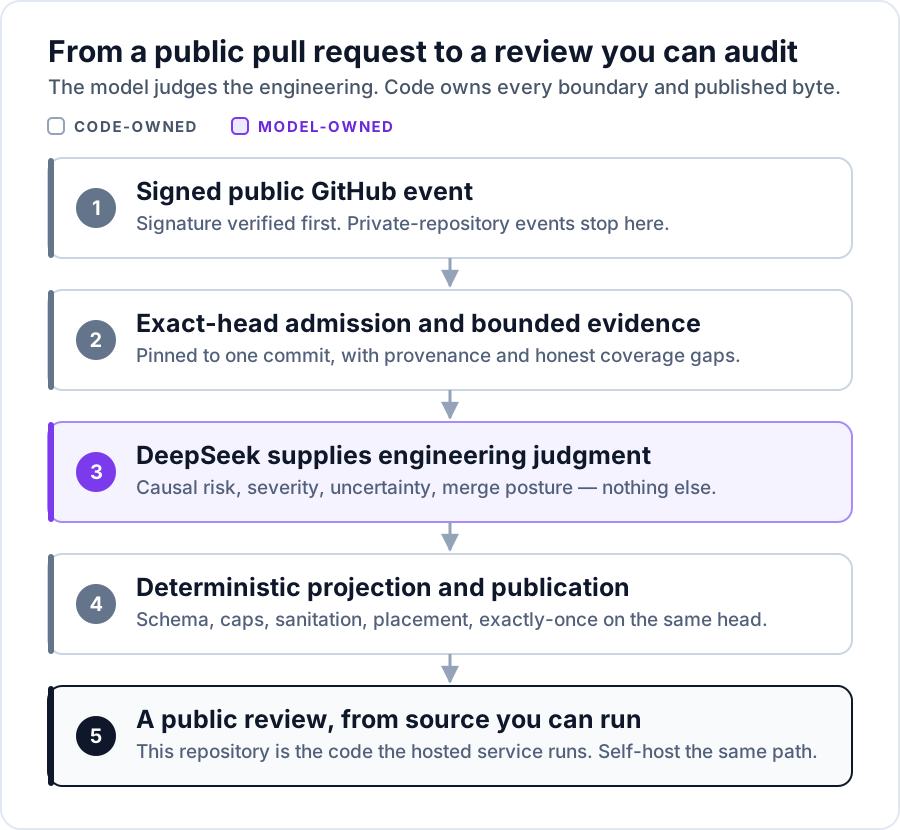
Verify and admit
Verify the webhook signature, enforce the public-only boundary, and pin the exact pull-request head.
Retrieve evidence
Gather bounded repository evidence with provenance, coverage, and explicit gaps.
Judge and present
Use model judgment for causal engineering risk, then compress it into owner actions and placement requests.
Project and publish
Sanitize, place, account, recover, and publish idempotently to the exact head that was reviewed.
Privacy and trust, plainly
The hosted service reviews public repositories only. Its active source and data boundaries are inspectable.
Private events stop early
After signature verification and minimum visibility parsing, a private event is acknowledged and discarded before product storage, provider processing, or GitHub mutation.
Public-run retention is stated
Run records, artifacts, provider traces, and logs follow documented retention windows. Historical private records were not deleted.
Provider processing is disclosed
Selected public evidence, prompts, and output are sent to DeepSeek. Read the full privacy and retention details.
Join the project
Inspect the source, report a reproducible problem, or help sharpen what useful engineering judgment looks like.