Why I Killed My AI Code Review SaaS (4,000+ Repos) Right Before Monetization
I grew an AI code review GitHub App to 500+ installs and 4,000+ repos. Here is why the rise of vibe coding forced me to abandon the paid tier and pivot to building local context infrastructure.
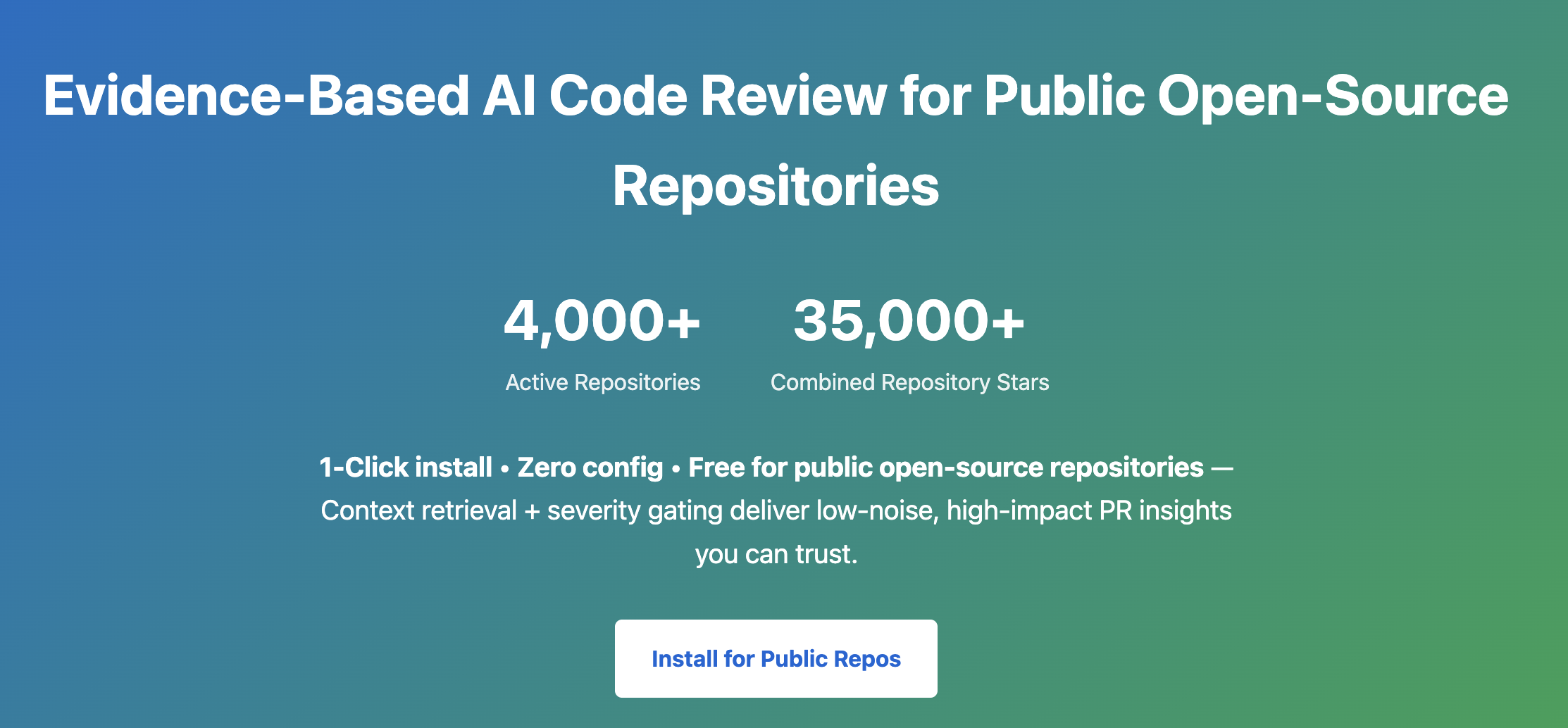
Over the last year, I built an AI code reviewer called LlamaPReview.
The metrics validated the premise: 535 active GitHub App installations, over 4,000 repositories covered, and a measured 61% signal-to-noise ratio in a space notorious for false positives.
The logical next step was obvious. The Stripe integration was ready. The plan for this month was to flip the switch on a paid tier for private repositories and transition into a proper Micro-SaaS.
Instead, on May 1, 2026, I am pausing the private tier entirely and walking away.
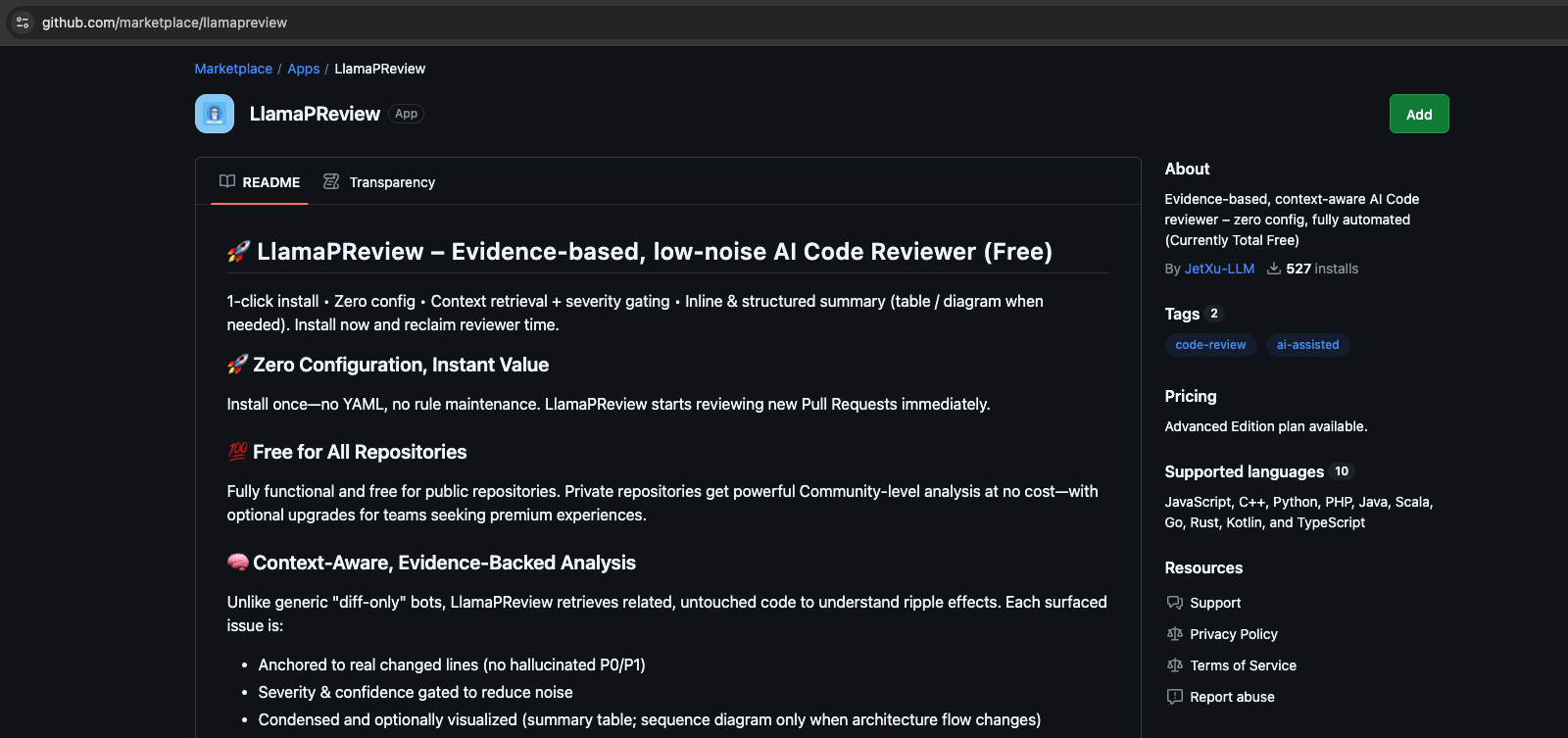 By April 2026, LlamaPReview had reached 535 active installs on GitHub Marketplace.
The Paradigm Shift: Vibe Coding Changed the Math
When I started building LlamaPReview, the scarce problem in engineering was catching bugs in human-written pull requests without overwhelming developers with noise.
But the software landscape shifted beneath our feet.
With the unstoppable acceleration of “vibe coding” and AI-native development workflows (like Cursor and Copilot Workspaces), the traditional standalone AI code review bot is rapidly becoming a relic.
AI is now generating code at a volume that makes traditional post-facto review impossible. When an autonomous agent dumps a massive, multi-file PR, even reading an AI bot’s summary of that AI-generated code becomes exhausting.
Reviewing diffs after the fact feels like patching a leaky pipe when the entire plumbing system is being replaced.
A user on Reddit recently summed up my exact realization:
“If agents are writing more of the code, then whoever controls the inputs (context, constraints, architecture) controls the outcome. Everything else becomes cleanup.”
Traditional code review is becoming cleanup. And a standalone GitHub App for code review is rapidly becoming a native IDE feature, not a standalone business.
Moving Upstream: The Context Bottleneck
As an architect with 15 years of building mission-critical systems, I realized my heart just wasn’t in maintaining a dying paradigm. Being “almost right” on a PR comment isn’t enough anymore.
The real computing frontier isn’t understanding code diffs after they are written. It is understanding full knowledge environments before the generation happens. AI needs deterministic context, not just a reviewer.
But in the real world, context doesn’t just live in Git repositories.
For IT architects, strategy consultants, and finance professionals, context lives in a messy, scattered graveyard of half-finished PowerPoint decks, complex Excel models, legal PDFs, and buried email threads.
I needed a way to make AI understand my entire working environment so it could generate reliable outputs the first time, rather than needing an AI to review its mistakes later.
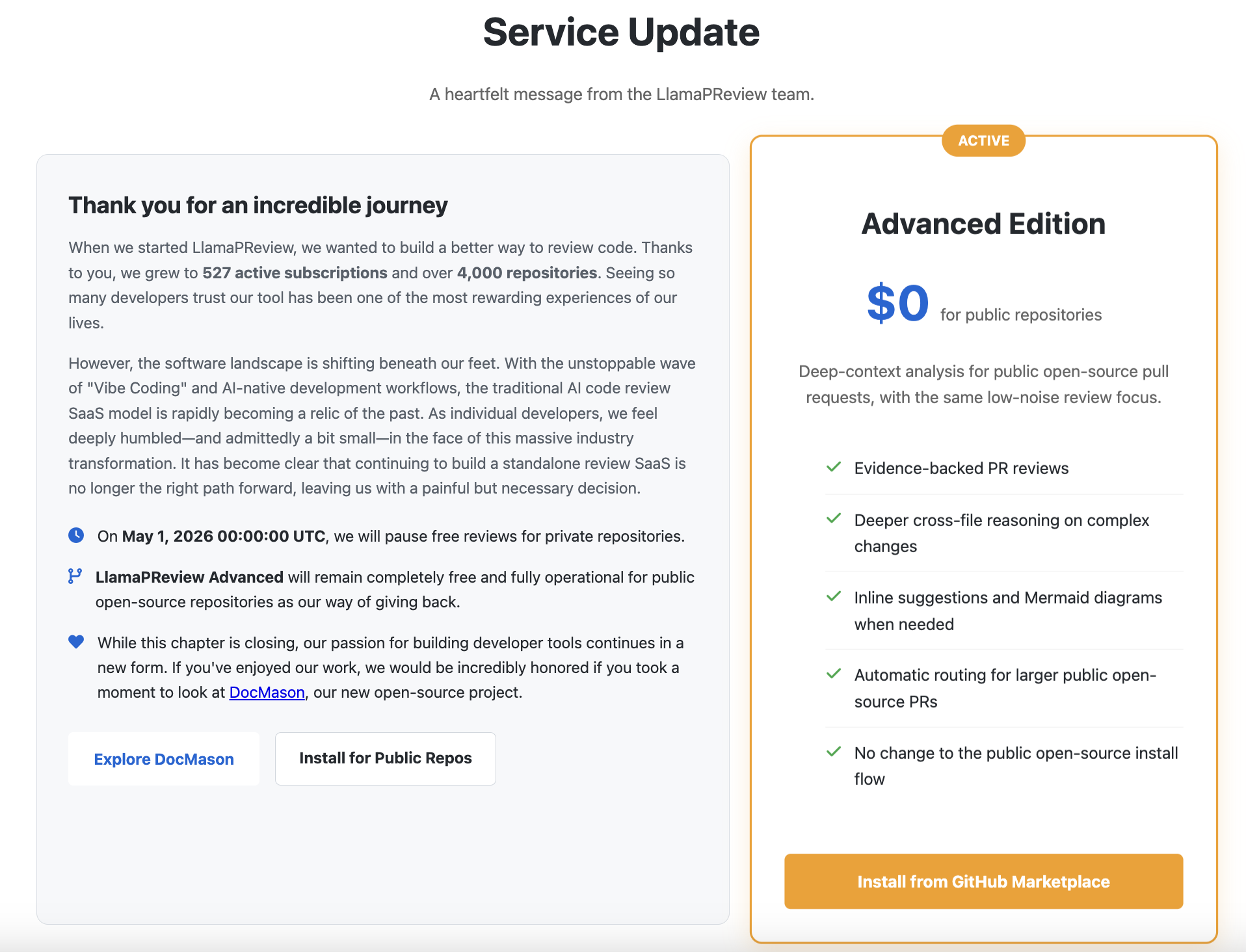 The pivot became explicit: private reviews pause on May 1, 2026, while the public open-source path stays alive.
Enter DocMason
I stopped building tools for cleanup and started building infrastructure for context.
I am now pouring my time into my new open-source focus: DocMason.
DocMason is a local-first, provenance-first knowledge base for AI-assisted deep research over private work files. It is not another vague document chatbot or a thin RAG wrapper. It is built to compile unstructured office artifacts into deterministic knowledge infrastructure that agents can actually use to generate serious, consulting-grade outputs.
It keeps the workspace local, preserves Office-native structures (like hidden Excel sheets and PowerPoint speaker notes), and returns evidence-backed output with exact citations back to the underlying files.
The Takeaway
The public open-source tier of LlamaPReview will remain completely free and operational. As for the private SaaS side, it is essentially a turnkey Micro-SaaS with an active user base. If someone in the community wants to take the keys and run with it, my DMs are open.
Otherwise, the private review tier quietly spins down on May 1, 2026.
Knowing when to pivot is hard, especially when the dashboard metrics look good. But building for the future means recognizing when a paradigm has shifted.
If you deal with mountains of private files and are tired of AI hallucinations ruining your context window, I’d be honored if you checked out the demo on the DocMason GitHub repo.
If you’ve ever abandoned a validated project because the underlying market completely shifted, I’d love to hear your story.