The Future of AI Code Review Is a Digital Staff Engineer
Generic AI reviewers fail where enterprise context begins. The next valuable AI code reviewer will behave like an internal digital staff engineer: platform-aware, company-aware, human-looped, and accountable for merge trust.

TL;DR: The next valuable AI code reviewer will not be the bot that leaves better comments on a diff. It will behave like an internal digital staff engineer: someone with access to code, platform standards, deployment reality, incident history, business-module rules, and human experts. The hard problem is no longer reviewing code. It is deciding whether machine-written change has earned the right to enter a company’s software system.
In April, I wrote about why I killed my AI code review SaaS.
At the time, my conclusion was that the old standalone AI review surface was dying. I still believe that. A bot that comments on a pull request after the meaningful decisions have already happened is too easy for platforms to absorb, too easy for teams to ignore, and too shallow for the coming volume of AI-written code.
But I now think that conclusion was not strong enough.
The future of AI code review is not simply an “acceptance runtime” that checks whether a pull request satisfies a task. That is useful, but it is already behind the real problem.
The real problem is this:
A reviewer that does not know the company cannot review the company’s code.
That sounds obvious only after the first painful failure.
The Failure Mode I Cannot Unsee
My day job is architecture and DevOps leadership. I have watched code review move through three eras.
First, leaders and senior engineers reviewed human-written code by hand.
Then AI started assisting humans reviewing human-written code. That was the world where LlamaPReview made sense: low-noise findings, repository context, better signal than generic comments.
Now AI is writing more of the code. Vendors use AI. Internal teams use AI. Agents generate pull requests. Humans cannot read everything. Worse, humans cannot even read all of the AI review output, and they still do not know whether to trust it.
Recently I saw a failure that clarified the next era for me.
I will keep the details sanitized. The shape is what matters.
Inside a large enterprise platform, we had many internal standards and best practices around business modules. Some were written down. Some lived in architecture docs, review habits, platform conventions, past incidents, deployment constraints, and the memory of people who had operated the system for years.
A supplier shipped code that had been written with AI assistance. It looked reasonable. Generic AI review did not catch the issue. Even strong third-party models would not necessarily catch it, because the missing fact was not sitting neatly inside the diff.
The bug appeared later in a corner case.
The root cause was not that the code was syntactically bad. It was not that the AI forgot an obvious null check. The implementation violated an internal technical best practice for one business module. The generated code did not know that law. The reviewer did not know that law. The AI reviewer did not know that law either.
That is the part that should make engineering leaders uncomfortable.
The system did not fail because nobody reviewed the code. It failed because the reviewer was not a real member of the engineering environment.
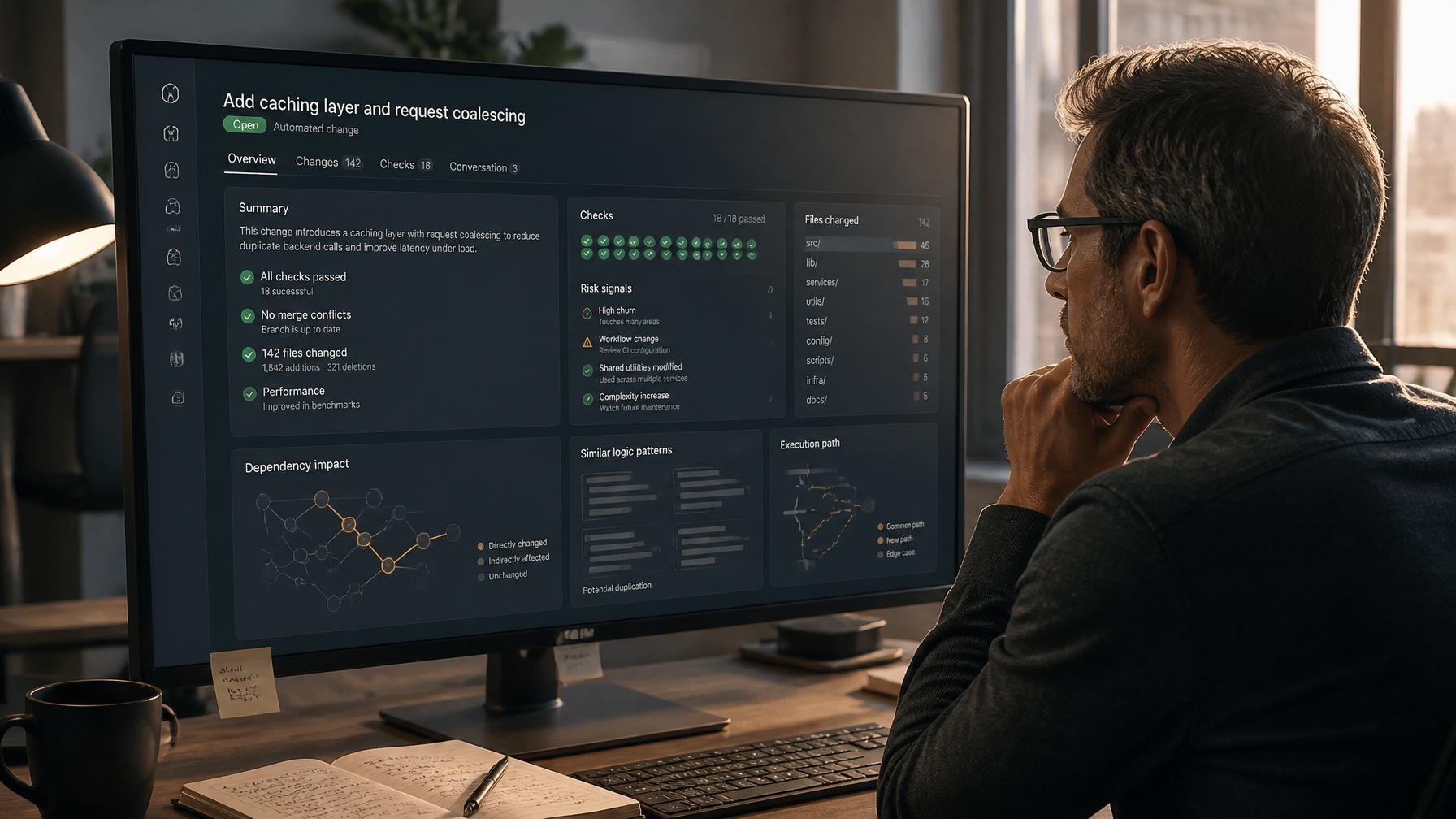 The hardest agent PRs do not look broken. They look complete, green, and plausible, while the real risk sits in company-specific knowledge outside the diff.
The Old Reviewer Was Reading The Wrong Object
For years, code review had a fairly stable object: the diff.
A human author had a task, changed code, and opened a pull request. The reviewer inspected the diff, asked questions, checked tests, and used their own memory of the system to decide whether the change was acceptable.
AI changed the author, then changed the volume, then changed the trust problem.
When an agent writes the code, the diff is no longer enough. A pull request might be locally correct and globally wrong. It might satisfy the issue and violate a platform rule. It might pass tests and weaken an operational invariant. It might reuse the right library but ignore a business-module standard that only exists in internal architecture practice.
This is why I think the current phrase “AI code review” is too small.
The review target is no longer code.
The review target is the relationship between code and the institution that must live with it.
That institution includes the repository, but it also includes platform engineering, DevOps, security, business architecture, deployment topology, incident memory, compliance boundaries, vendor rules, ownership maps, and senior engineers who know why a strange-looking convention exists.
A generic reviewer can read code. A real reviewer understands the environment the code is entering.
Acceptance Runtime Is Necessary, But Not Enough
The natural next step is an acceptance runtime.
Instead of spamming comments, the reviewer builds a merge case: what the task asked for, what changed, what tests prove, what risks remain, whether the pull request should be approved, split, blocked, or escalated.
That is a real improvement. It is where a lot of AI review products should go next.
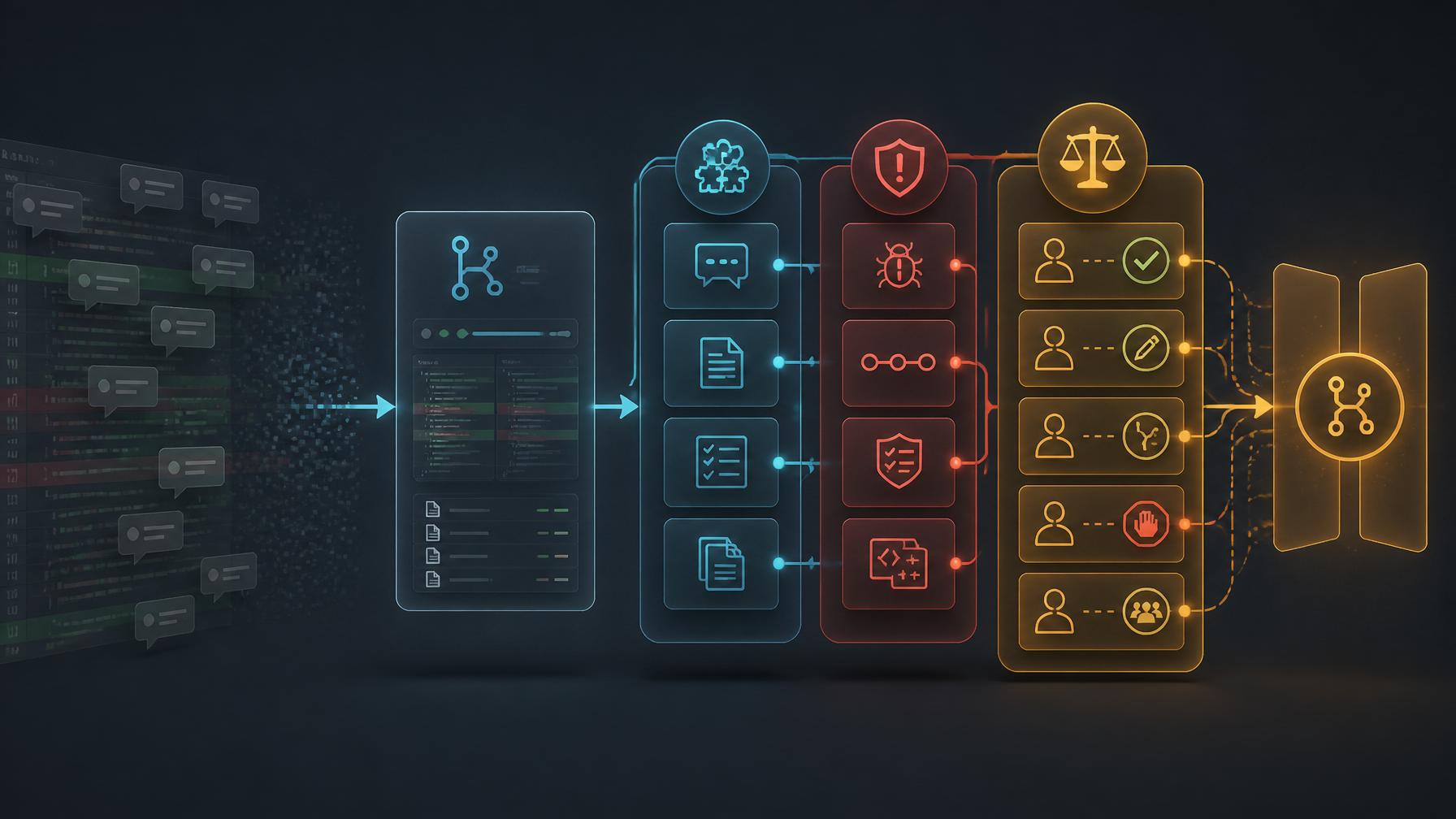 Acceptance runtime is the first serious product shape after comment bots: turn a pull request into evidence, risk isolation, and merge judgment.
But my enterprise failure case shows why acceptance runtime is still only the floor.
If the acceptance runtime only sees the issue, the diff, the tests, and a shallow repository snapshot, it will miss the same class of risk. It will confidently judge the work against incomplete law.
In serious enterprise software, the hardest rules are not always local to the repository.
They live in platform standards. They live in deployment pipelines. They live in service catalogs, incident reports, runbooks, architecture decision records, audit requirements, release windows, data contracts, and the head of the one engineer everyone asks before touching a critical business module.
So the product question changes.
The winning AI reviewer will not be the one with the best model in isolation.
It will be the one allowed to become an internal digital employee.
The Product Form: A Digital Staff Engineer
I do not mean “digital employee” as a cute metaphor.
I mean a permissioned AI worker that can access the same classes of knowledge a serious internal reviewer would use, while staying inside governance boundaries.
The future AI code reviewer needs five capabilities.
First, it needs enterprise memory. It must know internal standards, business-module conventions, architecture decisions, past exceptions, and why certain shortcuts are forbidden even when the code compiles.
Second, it needs platform awareness. It must understand deployment topology, CI/CD rules, runtime constraints, feature flags, observability, shared libraries, and the difference between code that works in a unit test and code that survives production.
Third, it needs organizational context. It must know who owns a boundary, which team can approve a deviation, and when a vendor change requires internal engineering review instead of a normal rubber stamp.
Fourth, it needs human-in-the-loop escalation. A strong reviewer should not hallucinate confidence when it lacks internal law. It should ask the platform owner, architecture lead, security reviewer, or module expert, then preserve the answer as future review law.
Fifth, it needs merge accountability. The output should not be a pile of comments. It should be a merge trust case: the claim, the evidence, the violated or satisfied standards, the runtime risk, the open questions, and the recommended decision.
That is no longer a code review bot.
That is a digital staff engineer.
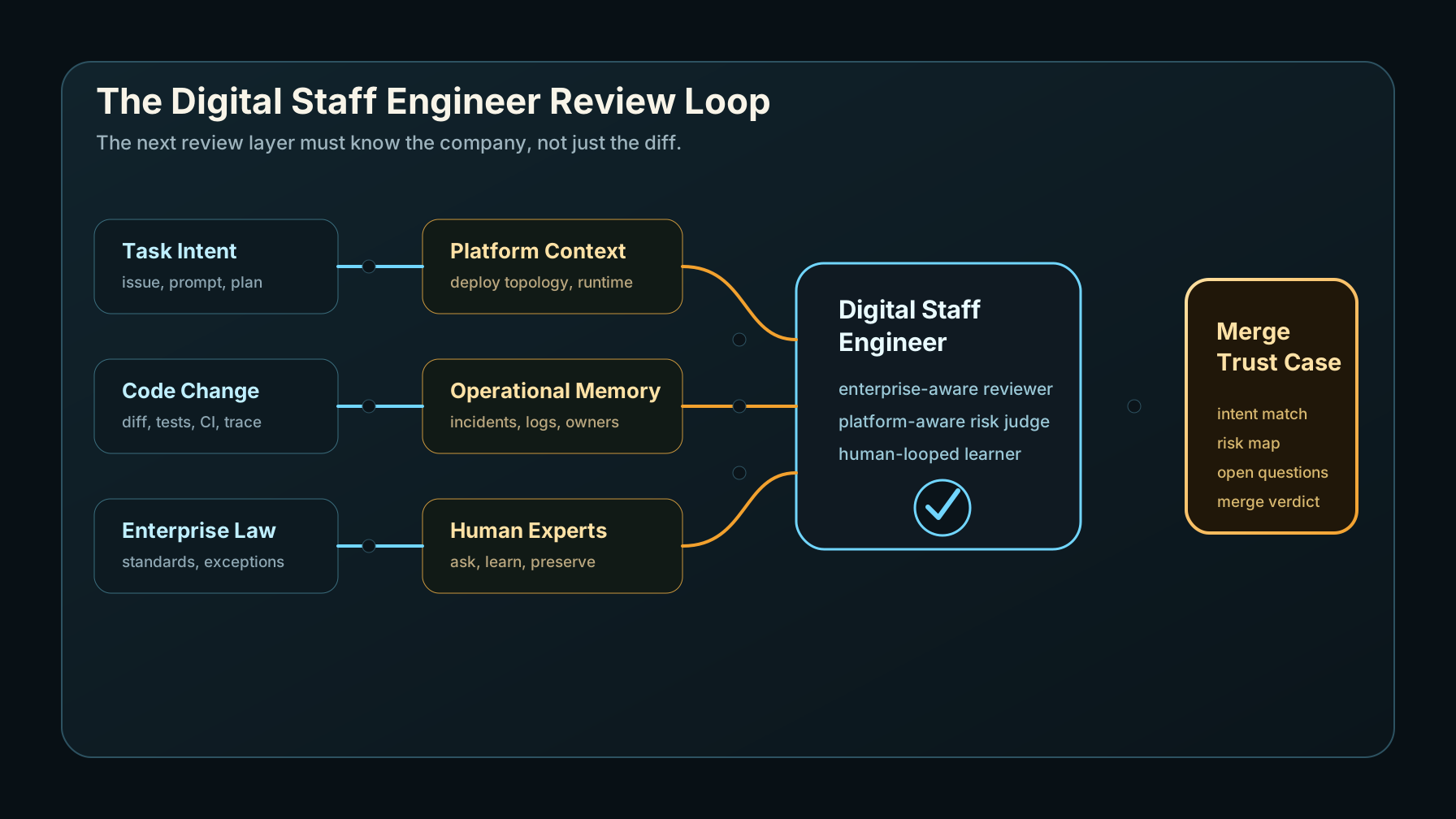 The next review layer must combine task intent, code change, enterprise law, platform context, operational memory, and human expertise before it can produce a real merge trust case.
Why Generic AI Review Will Hit A Ceiling
This is where many current tools will struggle.
GitHub is already teaching developers how to review agent pull requests differently. Its May 2026 guide, “Agent pull requests are everywhere. Here’s how to review them.”, focuses on where agent PRs hide risk: CI changes, code reuse blindness, hallucinated correctness, agentic ghosting, and untrusted input flowing into LLM-powered workflows.
That is the right direction.
GitHub’s June 2026 changelog also matters: Copilot code review now supports repository-level AGENTS.md. That means review feedback is starting to consume repository law rather than only diff hunks.
CodeRabbit is moving its language in the same direction. Its post on the intent bottleneck in code review frames review around understanding what changed, why it matters, what risk exists, and what is about to ship.
The paper “More Code, Less Reuse” adds the research warning: agentic pull requests can look acceptable while accumulating redundancy and maintainability debt. Reviewers may react neutrally or positively to AI-generated contributions even when quality issues are present.
NVIDIA’s work on Verified Agent Skills points at the same governance pressure from another angle: agent capabilities need transparency, provenance, scanning, signing, and risk checks before teams can trust them.
These signals are all useful.
But they still mostly describe the first half of the problem: making AI review more context-aware and governance-aware.
The second half is harder.
The reviewer must become company-aware.
A third-party model can understand Python. It can understand a pull request. It can understand a public framework. It can even understand a repository if given enough retrieval.
But it cannot magically know why your enterprise platform forbids a specific shortcut in one business module, why one deployment path requires a different fallback, why a vendor change needs an internal owner, or why a test is insufficient because the real failure only happens under a production traffic pattern.
Unless that knowledge is made available, the AI reviewer is just a very smart stranger.
And serious software should not be reviewed by a stranger.
The New Artifact: A Merge Trust Case
If I were designing the future product, I would not start with inline comments.
I would start with the artifact a human approver actually needs.
Before merge, the digital staff engineer should produce a merge trust case.
It should answer five questions.
What did the agent or developer intend to change?
Which internal standards, platform rules, and business-module laws apply?
Where does the implementation satisfy those rules, and where does it deviate?
What evidence supports the merge: tests, traces, deployment checks, ownership approvals, prior incidents, and code references?
What remains unknown, and which human expert must answer before the change can safely ship?
That last question matters most.
The future reviewer should not pretend that every answer is already in the context window. Real staff engineers do not do that. They ask the person who knows. They route the question. They remember the answer next time.
This is the difference between an AI tool and an AI colleague.
The tool produces output.
The colleague improves the institution.
Human In The Loop Is The Moat
A lot of AI tooling still treats human-in-the-loop as a temporary weakness.
I think that is backwards.
For enterprise code review, human-in-the-loop is how the system learns the law that was never written down.
The important loop is not “AI suggests, human approves.”
The important loop is:
- AI detects that a decision depends on company-specific knowledge.
- AI asks the right internal expert.
- The expert answers once.
- The answer becomes future review memory.
- The next similar PR is reviewed against that newly captured law.
That is how the organization stops losing the same judgment across chat threads, vendor handoffs, and PR comments.
This is also where the economics change.
Generic review tools compete on model quality and comment usefulness. Internal digital reviewers compete on accumulated institutional memory. The longer they operate inside a company, the more valuable they become, provided the governance is good and the memory stays clean.
That is a much stronger moat than “we found another possible bug.”
What Would Prove This Prediction Right
This thesis is not meant to be philosophical. It should be falsifiable.
If I am right, the next serious wave of AI code review products will stop measuring themselves mainly by comment quality. They will start selling and building around enterprise integration depth.
They will connect to architecture docs, service catalogs, CI/CD systems, incident systems, ownership graphs, feature flag platforms, standards repositories, and internal knowledge bases.
They will produce review dossiers, merge trust cases, or acceptance packets rather than line comments alone.
They will ask questions inside the company instead of guessing.
They will have permission models that look less like “install this PR bot” and more like “onboard this digital engineering worker.”
They will treat company-specific standards as first-class review law.
They will remember why a human expert overrode or confirmed a risk.
And the most trusted tools will not necessarily be the ones with the flashiest public model. They will be the ones most deeply embedded in the company’s engineering nervous system.
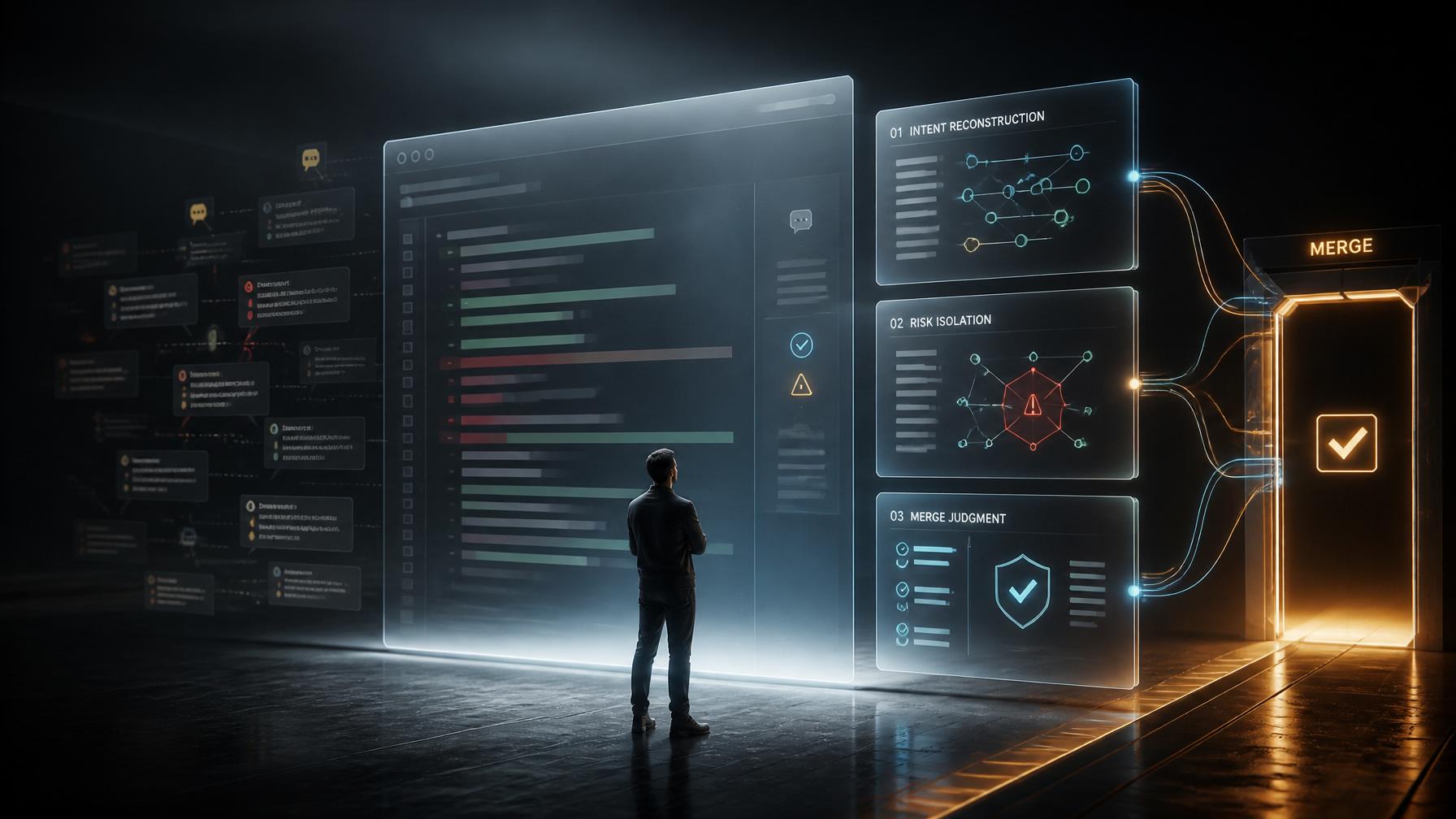 The merge button is more than a UI control. In agentic development, it is where enterprise knowledge, platform risk, and human responsibility meet.
Where This Can Go Wrong
There is a bad version of this future.
A digital staff engineer can become bureaucracy with a model attached. It can enforce stale rules. It can turn one architect’s preference into company law. It can ask too many humans too often. It can create a false sense of safety because the dashboard looks complete.
The access problem is also real.
If the reviewer can touch the same knowledge an employee can touch, then governance matters. Permissions, audit logs, data boundaries, vendor access, prompt injection, and memory hygiene become part of the product. A digital staff engineer that leaks context or learns the wrong lesson is dangerous.
So I am not arguing for blind autonomy.
The future reviewer still needs boundaries. It needs explainability. It needs replayable evidence. It needs clear escalation. It needs humans to own the final judgment, especially when product, compliance, architecture, or customer risk is involved.
But those limits do not make the idea weaker.
They are what make it real.
The Real Future Of AI Code Review
In April, I thought I was walking away from AI code review.
Now I think I was walking away from the first product surface.
The old surface was a commenter.
The next surface is an acceptance runtime.
The real destination is a digital staff engineer.
That is the shift I think many teams will feel before they can name it. Code generation becomes cheap. AI review output becomes too abundant. Generic models become good enough to sound convincing. The scarce layer moves to institutional trust.
The question will not be:
“Did the AI review the code?”
The question will be:
“Did the reviewer understand the company well enough to approve this change?”
For open-source projects, repository context may be enough.
For serious enterprise systems, it will not be.
The future of AI code review belongs to systems that can become internal colleagues: company-aware, platform-aware, evidence-bearing, human-looped, and accountable for merge trust.
The winning reviewer will not be the smartest stranger in the pull request.
It will be the digital staff engineer that knows why your company built the system this way.